REVIEW · BAY OF ISLANDS
Bay of Islands: 12,000ft Skydive
Book on Viator →Operated by Skydive Bay of Islands · Bookable on Viator
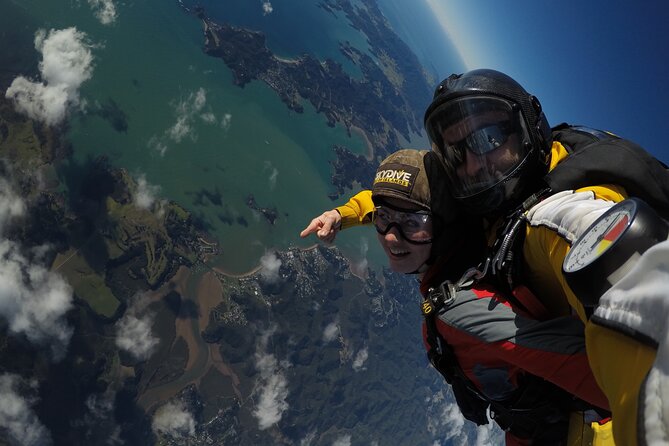
Your stomach will do a quick flip. A 12,000ft tandem skydive over the Bay of Islands turns that fear into a front-row seat for 144 islands and turquoise water, with 40 seconds of freefall that feels longer than you expect. The big heads-up: weather can change plans, and you’ll need to call ahead to confirm jump conditions.
What I like about this setup is how direct it feels. You get a clear plan, safety gear provided, and multiple jump times offered so the day stays moving. One practical consideration: you must bring a printed voucher, wear closed-toed shoes, and you’re capped at 100kg, so check those items before you head to the drop zone.
In This Review
- Key highlights you’ll care about
- Bay of Islands 12,000ft Skydive: what makes this one worth it
- Getting to the drop zone from Paihia and Kerikeri
- Your tandem jump at 12,000 feet: what the 40 seconds feels like
- The Bay of Islands aerial route: 144 islands, Cape Brett, and more
- The northern edge of New Zealand’s story
- The archipelago of 144 islands
- A coastal town view and a historic waterfront across the bay
- Historic grounds tied to modern New Zealand
- The largest island in the Bay of Islands
- An inland town with some of the oldest stone buildings
- A famous Cape Brett rock formation and cliffs
- Matauri Bay and the Rainbow Warrior memorial
- Photos, video, and how to remember what you saw
- Safety, weight limits, and the rules that keep it smooth
- Price check: why $93 can be a fair deal for 12,000ft
- Who should book this Bay of Islands skydiving (and who should pause)
- Should you book this 12,000ft Bay of Islands skydive?
- FAQ
- What is the starting location for the Bay of Islands 12,000ft skydive?
- Does this experience include pickup?
- How long does the skydive take?
- How high is the jump?
- How long is the freefall?
- What is the minimum age?
- Is there a weight limit?
- What should I wear?
- Do I need to bring anything like a voucher?
- Can I skydive if I scuba dived recently?
- When should I call to confirm conditions?
Key highlights you’ll care about
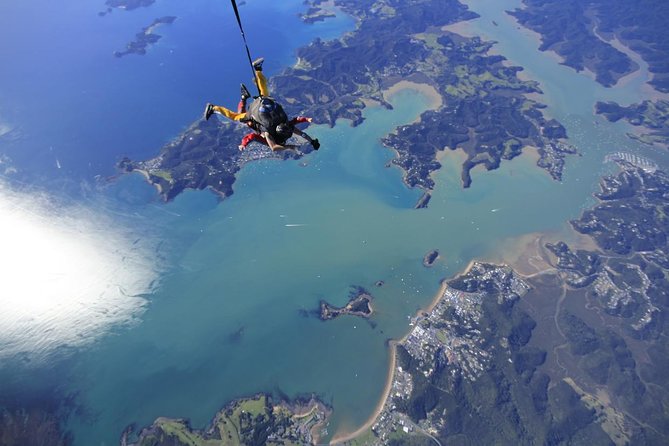
- 12,000ft tandem jump with an experienced instructor (you don’t have to jump the plane solo)
- Full 40 seconds of freefall before you slow down and glide back to land
- Pickup and drop-off in central Paihia and Kerikeri to keep your morning simple
- Multiple jump times throughout the day, which helps when weather affects schedules
- Small operation for a big view, with a maximum of 20 travelers
- Photo and video add-ons if you want something to keep besides your shaky bragging rights
Bay of Islands 12,000ft Skydive: what makes this one worth it
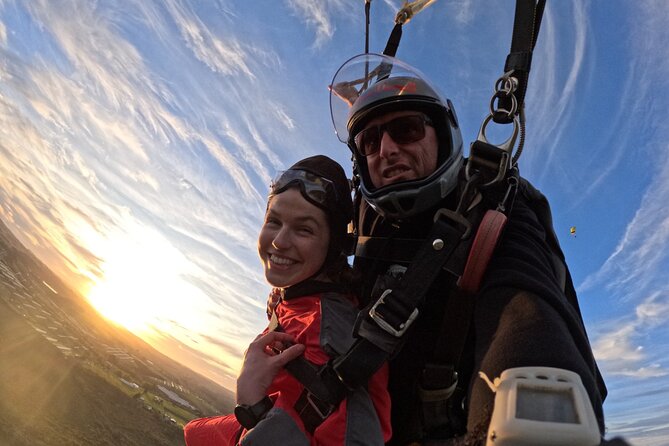
This isn’t just a skydiving ticket. It’s a Bay of Islands ticket, from above. When you jump, you’re looking out at a coastal area famous for clear water, secluded bays, and an island chain that makes the coast look like it was drawn with a careful hand.
At 12,000ft, you’ll have time to get a handle on what’s happening. Then comes the part that makes people book in the first place: a 40-second freefall with an instructor. You’ll be dealing with wind, sound, and that sudden drop feeling—then the change when you slow down and start to drift.
The other reason this feels like good value is the “day structure.” You’re not stuck waiting around for hours with nothing to do. The operation offers multiple jump times, and they build in the real-world timing you’d expect from an aviation business.
You can also read our reviews of more tours and experiences in Bay of Islands.
Getting to the drop zone from Paihia and Kerikeri
Most people want a skydive day that runs on rails. This one tries to do that.
You’ll have pickup and drop-off from central Paihia and Kerikeri (plus the activity ends back at the meeting point). The start point listed for the experience is 182 Wiroa Road, Kerikeri 0293. If you’re staying outside those areas, you’d want to confirm how you’ll get to the shuttle or meeting point, since the tour data doesn’t promise hotel pickup everywhere.
One small detail that matters: jumpers get priority in the shuttle vans. If you’re traveling with friends who just want to watch, they may need alternate transport if the shuttle is at capacity. So if you’re bringing spectators, plan for that early.
Your tandem jump at 12,000 feet: what the 40 seconds feels like
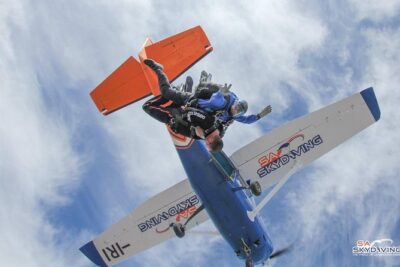
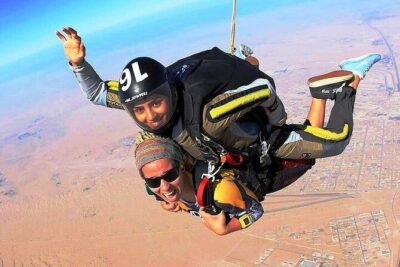
You’ll jump tandem, meaning you’re attached to an instructor the whole time. That’s the key comfort factor. You’ll get training and safety equipment, and the instructor handles the technical side while you focus on the experience.
Here’s the rhythm to expect:
- You’ll go up to height from the aircraft, then you’ll exit and begin freefall for 40 seconds.
- After the freefall, you’ll transition to a slower, more controlled descent and float back down.
A few practical notes. You have a minimum age of 8, so this can work for families that are ready for a real adrenaline activity (not a gentle “look at clouds” moment). You’ll want to dress for comfort and stability: closed-toed shoes and clothing that won’t annoy you when strapped in.
Also keep the schedule buffer in mind. The skydive itself typically takes about 1.5 hours, but you should plan for 2–4 hours total. Weather can cause changes, and aviation operations sometimes need to adjust.
The Bay of Islands aerial route: 144 islands, Cape Brett, and more
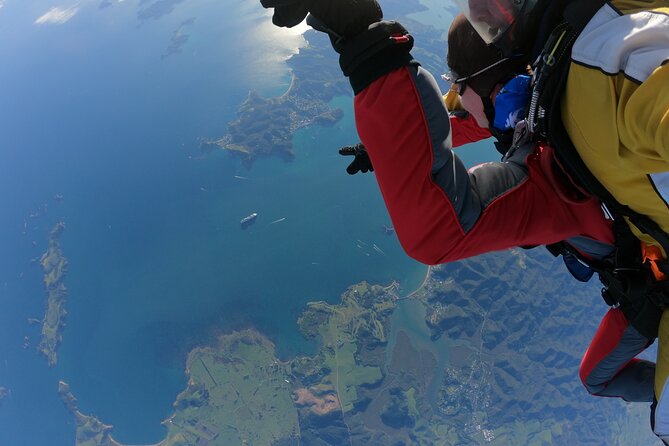
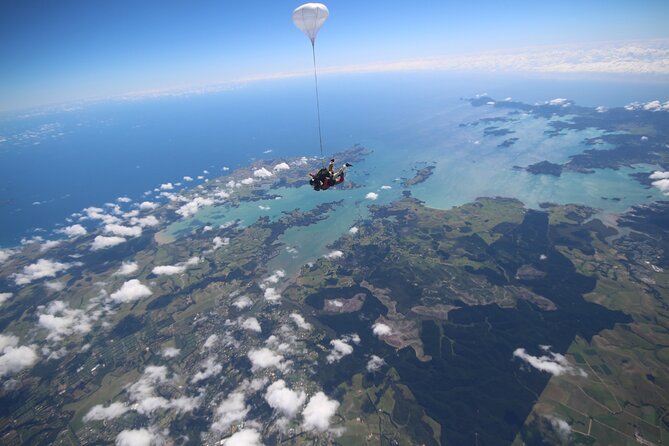
This is where the Bay of Islands really earns its name. From the air, the coast looks engineered by geology and time: scattered islands, rocky headlands, and pockets of water that look almost too clear.
You’ll fly over a route that includes these kinds of highlights, in the order they’re described for the experience:
The northern edge of New Zealand’s story
The far north is the northernmost tip of New Zealand, where the Pacific Ocean and the Tasman Sea meet. Even if you don’t see that exact meeting point clearly from your jump, it’s part of why this region feels so special. You’re over a boundary zone—two bodies of water with different personalities—and that shows in how the coast and ocean mix from above.
The archipelago of 144 islands
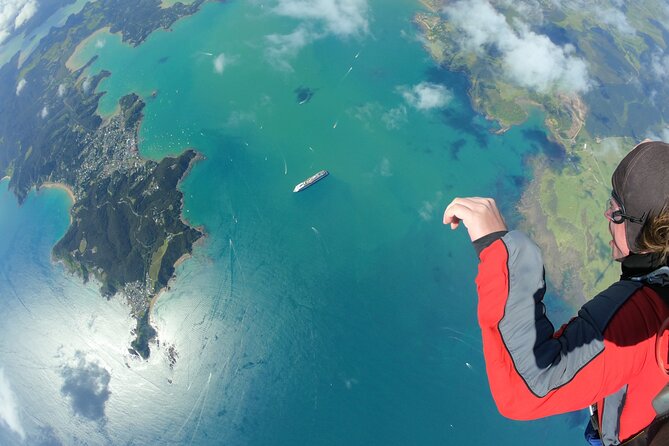
The star of the show is the island chain: 144 islands. From altitude, these islands aren’t just dots. You’ll see the spacing, the shape of bays, and the way color shifts over shallow water. It’s the kind of view where you’ll stop thinking in terms of “shoreline” and start thinking in terms of “island patterns.”
A coastal town view and a historic waterfront across the bay
Your route includes a coastal town where the bay views can be visible from the air, plus a historic town across the bay from Paihia. Those waterfront stretches are often what make people understand why the Bay of Islands is popular with sailors and swimmers: the coast isn’t just pretty, it’s structured with harbors and sheltered water.
Historic grounds tied to modern New Zealand
You’ll also pass over the birthplace of modern New Zealand, which adds a deeper layer to the scenery. From above, it’s easy to see why the location matters: waterways, land access, and a geography that connects the inland and coast. Even though you’re strapped in for skydiving, it still lands in your brain that you’re over places with real historical weight.
The largest island in the Bay of Islands
The route includes the largest island, known for hiking trails and crystal-clear waters. That’s the kind of detail you can actually use while you’re looking down: you might spot the island shape and then connect it to why people go there on foot and by boat.
An inland town with some of the oldest stone buildings
Next is a historic town inland from the coast, known for New Zealand’s oldest stone buildings and surrounded by lush greenery. From above, you won’t just see water and islands. You’ll see how land changes the picture—where vegetation thickens and the coastline stops being the only texture.
A famous Cape Brett rock formation and cliffs
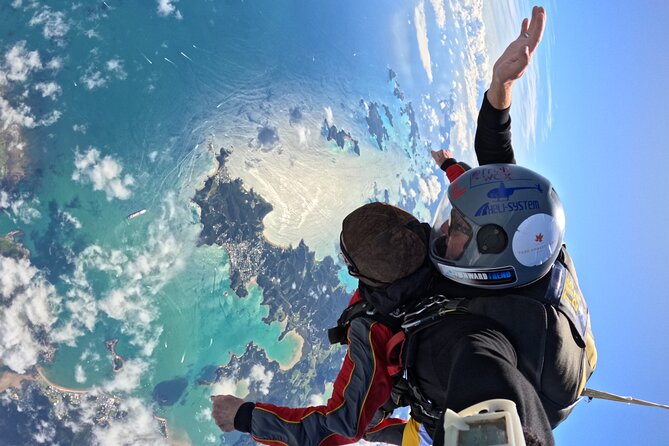
The Cape Brett area brings the drama: a famous rock formation with a natural archway off the coast of Cape Brett, plus a rugged peninsula known for coastal cliffs and panoramic ocean views. From the air, rock formations can look like symbols—perfect shapes against ocean. It’s the kind of view that makes you want to zoom in with your eyes even though you can’t.
Matauri Bay and the Rainbow Warrior memorial
One route stop includes a memorial near Matauri Bay dedicated to the Rainbow Warrior, which was bombed in 1985. You may not have time to process every detail the way you would on the ground, but it adds context to what can otherwise feel like just “pretty water and islands.”
Bottom line: the aerial route is designed to mix big-sky excitement with recognizable Bay of Islands features. That’s why this isn’t just a thrill ride.
Photos, video, and how to remember what you saw
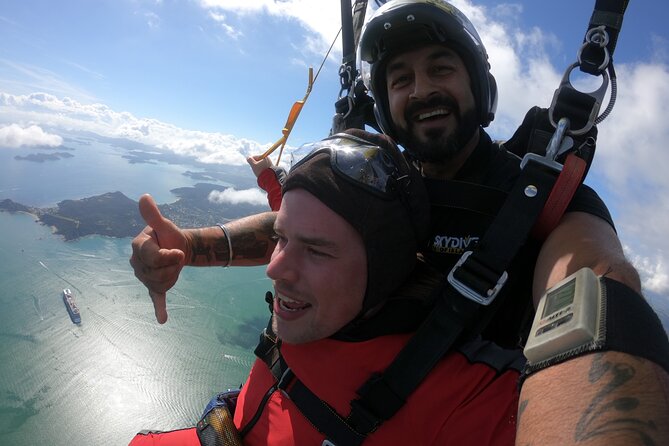
If you like keepsakes, this experience makes it easy. Souvenir photos and video footage are available to purchase. You can think of them as practical insurance: your brain is busy doing math like How loud is that and Why does my body feel like this? A camera gives you a second way to experience it later.
One more note from the operator’s broader offerings: higher-altitude jumps may be available on some days, and one review highlights supplemental oxygen during ascent for higher jumps. Your booking here is for 12,000ft, but if you’re curious about altitude options, it’s worth asking when you confirm your jump time.
Safety, weight limits, and the rules that keep it smooth
Skydiving is weather- and body-dependent. The good news is the rules are clear.
Key points you should not skip:
- Maximum weight: 100kg. If you think you may be near the limit, contact them ahead of time. (This isn’t the kind of check you want to learn at the gate.)
- You’ll be provided with training and safety equipment.
- Comfortable clothing and closed-toed shoes are required.
- Minimum age is 8 years.
- If you’re under 18, you’ll need signed consent from a parent or guardian.
- If you’ve had scuba diving in the last 24 hours, you cannot go skydiving due to pressure changes.
- If you have any pre-existing medical conditions, you should seek professional medical advice before you jump.
- Tickets/vouchers must be printed and shown on arrival.
- For open-dated vouchers, you need to book 7 days in advance of your jump date.
Also important: you must call 0800 GO JUMP 1 hour before your scheduled skydive time to confirm conditions are suitable for jumping. That’s part of the reality of flying here. Don’t skip it.
Price check: why $93 can be a fair deal for 12,000ft
$93 sounds straightforward, but value in skydiving isn’t just the number. Here’s what you’re getting for it:
- A tandem jump from 12,000ft, with an experienced instructor
- 40 seconds of freefall (that’s the main event)
- Pickup and drop-off from central Paihia and Kerikeri
- Training and safety gear provided
- Multiple jump times offered, which can reduce downtime on the day
So the price is covering more than “the jump.” It’s paying for aircraft time, instructor time, safety equipment, and the logistics to get you there from the Bay of Islands tourist hubs.
If you’re comparing value, pay attention to what else you might spend after the fact. Photos and video are optional add-ons, and food and drinks aren’t included. Budget for a snack and water before you go, so you aren’t trying to solve hunger mid-adrenaline.
Who should book this Bay of Islands skydiving (and who should pause)
I’d put this on your shortlist if you:
- Want a big adrenaline hit without needing skydiving experience
- Like the idea of pairing a thrill with a very specific coastal view (islands, bays, Cape Brett cliffs)
- Prefer a small-group experience (maximum 20 travelers)
- Are based around Paihia or Kerikeri and want pickup
I’d pause if:
- You’re dealing with the 100kg weight limit (plan alternatives if you’re near it)
- You’ve scuba dived in the past 24 hours
- You’re not able to follow the basic requirements (printed voucher, closed-toed shoes, calling to confirm conditions)
- You have medical concerns that could affect skydiving safety
Also be mentally ready for the “schedule reality.” Even with a planned time, weather can shift things. The experience tries to keep you moving, but the sky decides when it cooperates.
Should you book this 12,000ft Bay of Islands skydive?
If you’re torn between seeing the Bay of Islands from sea level and seeing it from above, booking this is an easy yes. You’re paying for a rare view—144 islands and Cape Brett from a height you don’t get anywhere else—then topping it with an instructor-led 40 seconds of freefall.
Book it if you can meet the requirements (weight, clothing, voucher rules) and if you’re okay with the weather-dependent nature of aviation. If you want a trip highlight that’s memorable for the right reasons—views and the pure physics of freefall—this one fits the bill.
One last tip: confirm your plan early with the 0800 GO JUMP call, and keep your day flexible. The best skydive experience is the one that runs on schedule—and that starts before you ever step into the aircraft.
FAQ
What is the starting location for the Bay of Islands 12,000ft skydive?
The meeting point listed is 182 Wiroa Road, Kerikeri 0293, New Zealand. The activity ends back at this meeting point.
Does this experience include pickup?
Yes. Pickup and drop-off are offered from selected locations in central Paihia and Kerikeri.
How long does the skydive take?
It typically takes about 1.5 hours to complete the skydive. You should allow 2–4 hours for the full experience due to weather and operational needs.
How high is the jump?
You jump tandem from 12,000 feet (3,658 meters).
How long is the freefall?
You’ll experience 40 seconds of freefall.
What is the minimum age?
The minimum age is 8 years.
Is there a weight limit?
Yes. There is a strict 100kg weight limit.
What should I wear?
Wear comfortable clothing and closed-toed shoes for safety.
Do I need to bring anything like a voucher?
Yes. Tickets or vouchers must be printed and presented upon arrival at the drop zone.
Can I skydive if I scuba dived recently?
No. If you went scuba diving in the last 24 hours, you cannot go skydiving due to pressure changes.
When should I call to confirm conditions?
You must call 0800 GO JUMP 1 hour before your skydive time to confirm conditions are suitable for jumping.